
Reflections from the SheShe Slam 2026 Media Tour at Academic City University
There are moments when an idea quietly leaves the realm of planning and begins to breathe in the world. This week was one of those moments.
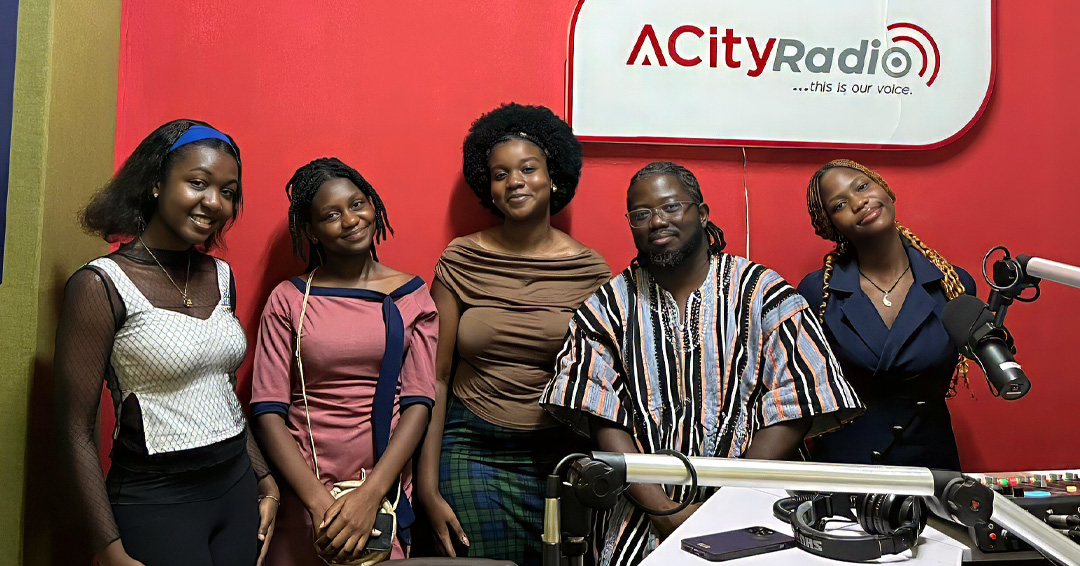
As part of the media conversations leading to SheShe Slam 2026, I had the opportunity to join a discussion at ACity Radio at Academic City University Yesterday morning. The conversation centered on this year’s theme, “Her Voice Is Not a Crime.”What was meant to be a radio interview quickly transformed into something deeper a sincere exchange about lived experiences, creative expression, and the courage it takes for women to speak openly in society.
Joining the discussion were some of the finalists of this year’s SheShe Slam including Abundance, Casandra, and Portia, young poets whose voices already carry remarkable clarity and conviction. My role in the conversation began simply: introducing the vision behind the platform and sharing why this year’s theme matters.
But something interesting happened after those opening remarks.
I found myself gradually stepping back, becoming less of a speaker and more of a listener. What unfolded on air felt less like an interview and more like a living panel of testimony.
One after the other, the poets spoke not only about poetry, but about personal realities. They spoke about the power of language, the responsibility of storytelling, and the everyday experiences that shape the words they bring to the stage. Their reflections were honest, sometimes vulnerable, and often strikingly bold.
Listening to them, I was reminded of something important about cultural work: the most meaningful spaces are the ones where the facilitator becomes an audience.
The real value of platforms like SheShe Slam is not in the event itself, but in the space it creates for voices to emerge.
What stood out during the discussion was how naturally the conversation moved beyond poetry and into broader social reflection. The theme “Her Voice Is Not a Crime” speaks directly to the realities many women still face when expressing themselves publicly whether in homes, institutions, or digital spaces.
Through poetry, these conversations become possible in a way that statistics and policy debates often cannot achieve. Poetry gives emotion to issues. It gives narrative to struggle. It gives human faces to topics that can otherwise feel abstract.
In that sense, what we are witnessing is more than performance.
It is art used as civic expression.
Over the years, I have increasingly come to appreciate the term artivism, the intersection where art meets social advocacy. Slam poetry, in particular, has proven to be one of the most powerful tools within this space because it allows individuals to reclaim narrative power.
When a poet steps onto a stage and tells their story, something shifts. The room listens. Perspectives widen. Silence breaks.
That morning at Academic City University, it became clear that SheShe Slam has grown beyond the idea that first inspired it. What began as a concept for amplifying women’s voices in poetry has gradually evolved into something more meaningful a cultural platform where creative expression intersects with social consciousness.
The poets who spoke during the interview did not present themselves as activists in the traditional sense. They simply spoke their truths. Yet within those truths were reflections on gender, dignity, resilience, and identity.
That is the quiet strength of poetry.
It does not shout instructions at society. It invites reflection.
As the conversation on the radio came to an end, I found myself thinking less about the upcoming event and more about the journey these poets are on. Their courage to speak openly about their experiences suggests that the next generation of artists is not only interested in performing but also in shaping conversations that matter.
For me, that is where the real promise of slam poetry lies.
Not just in the applause that follows a performance, but in the ripple effect of ideas that continue long after the stage lights fade.
With the SheShe Slam 2026 finals approaching this Saturday, anticipation continues to grow. Yet the most meaningful outcome may already be unfolding the emergence of voices that are learning to stand confidently in their own narratives.
If poetry can help create even a small shift in how communities listen to women’s experiences, then the stage has served its purpose.
Sometimes cultural change does not begin with policy.
Sometimes it begins with a microphone, a room willing to listen, and a poet brave enough to speak.
And in moments like these, one thing becomes clear:
A voice, especially a woman’s voice, should never be treated as a crime.