
Listening to Place, Holding the Line, and Building Poetic Integrity in Africa
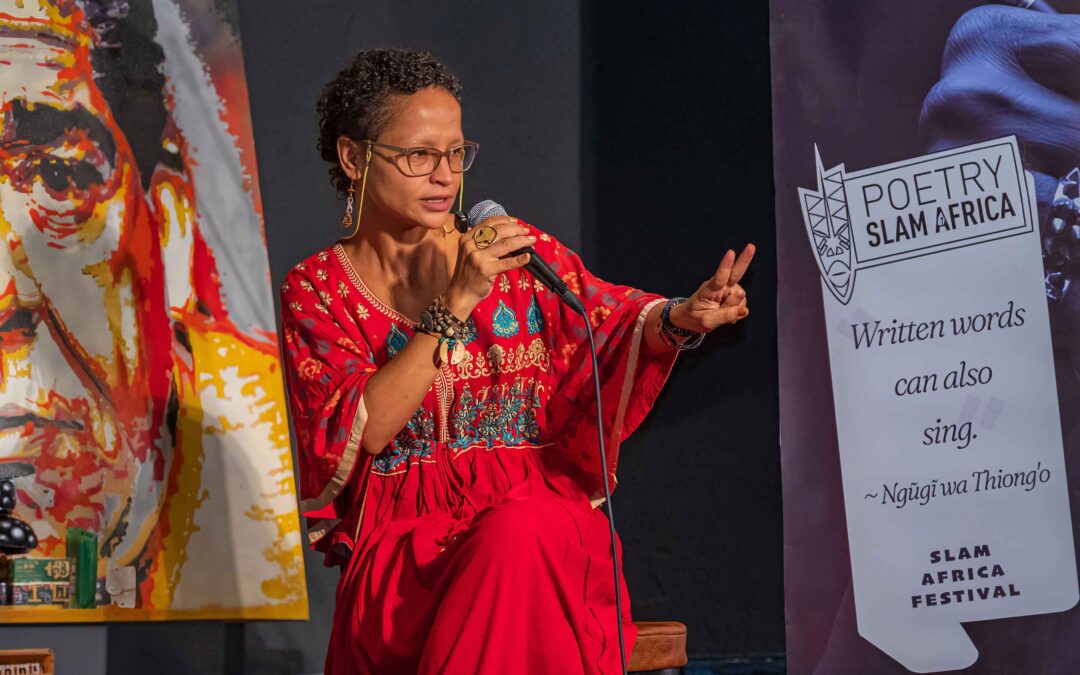
Some poets perform. Others build conditions for truth to survive. Raya Wambui belongs to the second lineage.
In African spoken word spaces, where voice often emerges before structure, and passion sometimes outruns protection, Raya Wambui has built a practice rooted in care, clarity, and cultural responsibility.
She is not loud about it. She is consistent.
With over fifteen years of writing, performance, adjudication, and community work, Raya’s contribution to spoken word poetry in Kenya and across the continent is less about spotlight and more about stewardship.
A practice shaped by place
Raya’s poetry is deeply anchored in place. Not as backdrop, but as source.
Her work listens closely to local realities, social contradictions, and the interior lives of people navigating inequality, resilience, and becoming. This grounding is what gives her voice its credibility. It is not borrowed urgency. It is lived context.
Her recognition as a Slam Africa Queen and as a laureate of the Nairobi edition of The Spoken Word Project affirmed what many in the community already knew: her voice carries both craft and conscience.
Beyond performance as destination
What distinguishes Raya is her refusal to treat the stage as the final destination of poetry.
She has served as an adjudicator for Slam Africa competitions, bringing fairness, discipline, and ethical consideration into spaces where emotions often run high. Her adjudication style reflects a belief that poetry spaces must be both expressive and accountable.
Currently, her leadership work with Female Poets Kenya at the regional level extends this philosophy. It is not enough for women to speak. They must be supported, protected, and positioned to grow.
Poetry as a system, not an event
Raya’s commitment to workshops, mentorship, and literary education reveals a deeper understanding of culture: that it survives through systems.
Her belief in what she describes as the immortality of art is not abstract. It shows up in how she trains poets, how she holds space, and how she evaluates work. Poetry, in her view, should heal without exploiting pain and challenge power without replicating harm.
This is cultural labor. Often invisible. Always necessary.
“Art must carry truth without destroying the vessel it comes through.”
Why Raya Wambui matters now
At a time when spoken word is expanding rapidly across Africa, Raya represents an essential counterbalance. She embodies the kind of leadership that insists on depth over speed, integrity over applause, and community over ego.
Her presence in selection rooms, juries, and mentoring spaces raises the quality of outcomes even when her name is not the headline.
And that is precisely why she belongs among the cultural enablers you should know.
Author’s Note
I curate voices not because they are popular, but because they are necessary.
Raya Wambui’s work reflects what I believe culture needs right now: people who protect meaning while allowing expression to evolve. Her journey reminds us that movements last longer when someone is paying attention to the foundations.